
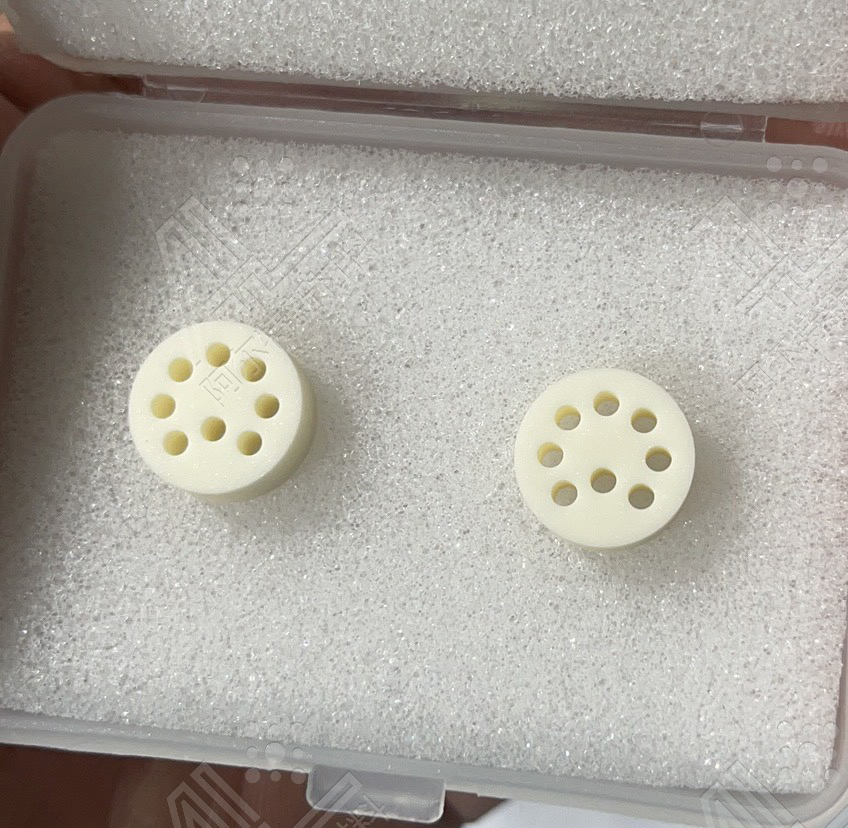
When mechanical engineers specify structural ceramics, the goal is typically absolute density and zero porosity. However, in specific thermal, fluid, and semiconductor handling environments, introducing a controlled void fraction fundamentally changes the material’s utility.
Porous alumina is engineered to combine the extreme high-temperature resistance and chemical inertness of aluminum oxide with a highly controlled, interconnected pore network. By precisely manipulating pore size (ranging from 0.1 to over 100 microns) and total porosity volume (typically 20% to 60%), R&D teams can leverage this material to solve OEM challenges involving uniform gas distribution, high-temperature filtration, and delicate substrate handling.
The Engineering Mechanics of Controlled Porosity
The performance of porous alumina is dictated by its precise microstructural architecture. While maintaining the baseline chemical resistance of Al2O3, the introduced porosity yields several unique physical properties:
-
Uniform Permeability: A consistent, interconnected open-pore structure allows for highly predictable fluid and gas flow rates with calculable pressure drops.
-
Reduced Thermal Conductivity: The high volume of trapped air acts as a thermal barrier, dropping the thermal conductivity from ~35 W/m·K (in dense alumina) to as low as 1-5 W/m·K, making it an exceptional high-temperature insulator.
-
Extreme Chemical Stability: Unlike polymer-based filters or metal meshes, porous alumina does not degrade in boiling acids (e.g., HCl, H2SO4) or highly caustic environments.
-
High Specific Surface Area: Provides a massive contact area for catalytic reactions or heat exchange within a minimal physical footprint.
Core Industrial Application Scenarios
1. Semiconductor Manufacturing: Vacuum Chucks and End Effectors
In front-end semiconductor fabrication, handling ultrathin (sub-100 micron) silicon wafers without inducing mechanical stress or micro-scratches is a primary engineering hurdle.
-
Porous Ceramic Chucks: Standard vacuum chucks use machined grooves that create localized stress points, leading to wafer warpage. Porous alumina vacuum chucks apply a perfectly uniform, diffused suction across the entire surface of the wafer.
-
Damage-Free Handling: Because the pores are micro-scaled and the ceramic can be ground to extreme flatness (Ra < 0.2 μm), the wafer remains completely flat and undamaged during high-speed lithography, inspection, and dicing processes.
2. Severe-Service Fluid and Gas Filtration
Standard filtration media—such as stainless steel or PTFE—fail catastrophically at elevated temperatures or in the presence of aggressive solvents.
-
Hot Gas Filtration: Porous alumina filter tubes are utilized in petrochemical and metallurgical processing to remove particulate matter from gas streams exceeding 1000°C (1832°F), where metallic filters would melt or oxidize.
-
Spargers and Diffusers: Used in chemical reactors and bioreactors to inject ozone, oxygen, or reactive gases into liquids. The highly controlled pore size generates uniform micro-bubbles, maximizing the gas-liquid mass transfer area.
3. Thermal Management and Furnace Infrastructure
For OEMs designing high-temperature industrial kilns or laboratory furnaces, maintaining precise thermal gradients is critical.
-
Structural Insulation: Porous alumina blocks and liners provide the structural rigidity of a ceramic with the thermal isolation properties of an insulator. They reflect radiant heat and withstand continuous operation at 1600°C (2912°F) without warping or spalling.
Specifying Porous Alumina: Machining and Sourcing Considerations
Procuring porous alumina requires an OEM supply chain capable of highly specialized post-sintering machining. Precision grinding a porous ceramic is exceptionally difficult; standard diamond grinding techniques run the risk of “smearing” the ceramic material and blindly sealing the open pores, which destroys the component’s permeability.
To achieve OEM-grade tolerances while preserving pore integrity, you must partner with an advanced technical ceramics manufacturer equipped with specialized coolant delivery and fine-grit machining protocols. When integrating porous alumina into your fluid or semiconductor hardware, verifying your supplier’s pore-size distribution data and permeability testing metrics is mandatory.